Introduction to Newcastle Solar Rebates 2025
If you have been sitting on the fence about solar power installation Newcastle, 2025 is the tipping point. A rare overlap of federal and NSW incentives is compressing pay-back times to their shortest in a decade. From an STC market that still hovers near the cap of $39.90 per certificate to the fresh Virtual Power Plant (VPP) bonus that jumps to $1 500 on 1 July 2025 energy.nsw.gov.au, real dollars are now up for grabs.
Layer on the Commonwealth’s new Cheaper Home Batteries Program promising about a 30 % upfront battery discount and it becomes clear why households and businesses across Lake Macquarie, Merewether and the Hunter are calling local solar installers Newcastle daily.
This article walks through each rebate, explains who qualifies, and shows how residential and commercial solar installation Newcastle customers can capture the full stack—without wading through government paperwork. As always, you can contact us here or click the link at the bottom with any questions.
The 2025 Rebate Stack at a Glance
Federal Small-scale Technology Certificates (STCs)
Every system under 100 kW earns STCs. Because the spot price has sat close to the $40 ceiling for most of 2025, the certificates still remove roughly a third of a system’s invoice before you even think about state schemes. A common 6.6 kW array receives about 82 STCs, translating to ≈ $3 270 off today’s prices cer.gov.au. Your installer claims them on your behalf—no forms, no queues.
Cheaper Home Batteries Program
From 1 July 2025, Canberra steps in with a national battery rebate worth around 30 % of the installed cost, calculated on usable kilowatt-hours. Unlike earlier grants, the discount appears on the quote the same way STCs do, which means cash flow stays in your pocket rather than arriving months later.
NSW Virtual Power Plant Incentive
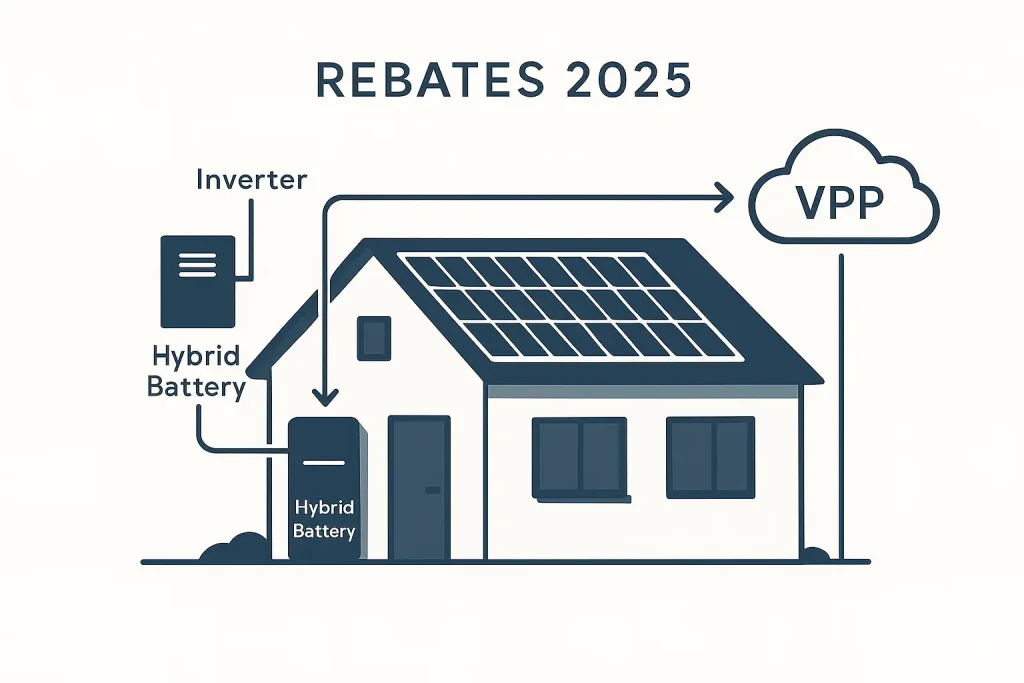
Sydney is scrapping its stand-alone battery rebate and instead doubling the incentive for households that plug their batteries into an approved VPP. The new payment—up to $1 500 depending on battery size—kicks in on the same day as the federal scheme, and you can stack the two. The combined effect trims a 10 kWh battery’s pay-back from about twelve years to well under nine for a typical Newcastle tariff.
Feed-in Tariff Benchmarks
While feed-in credits are no longer the star of the show, the Independent Pricing and Regulatory Tribunal’s 2025–26 benchmark still pays 4.8 – 7.3 c/kWh all day and up to the low-20-cent range during the evening on time-of-day plans. When excess energy is stored in a battery and released in peak slots, that extra margin further shortens ROI.
NSW-Specific Sweeteners You Might Miss
Grants for Apartments and Multi-Unit Sites
Many “split-metre” dwellings once missed out on rooftop incentives, but the Solar for Apartment Residents grant now covers 50 % of a shared system cost up to $150 000 per building. Strata managers can finally call solar panel installation Newcastle contractors without asking every unit owner to pitch in.
Local Council Top-Ups
Several Hunter councils still run micro-grants or low-interest loans for efficiency upgrades. They change quickly, so ask your installer to check Maitland or Port Stephens websites before signing a contract. Even a small 5 % top-up can shave months off pay-back.
Residential Returns: What a Typical Newcastle Home Sees in 2025
A three-bedroom house in Charlestown using 23 kWh per day can cover almost its entire daytime load with a 6.6 kW array and store the evening peak inside a 10 kWh battery. Upfront costs in mid-2025 look like this:
| Item | Sticker Price | Rebates Applied | Out-of-Pocket* |
|---|---|---|---|
| 6.6 kW tier-one panels + 5 kW inverter | $7 980 | STCs − $3 270 | $4 710 |
| 10 kWh battery (hybrid solar battery install Newcastle) | $10 600 | Fed battery discount − $3 180 NSW VPP − $1 200 | $6 220 |
| Total | $18 580 | $7 650 | $10 930 |