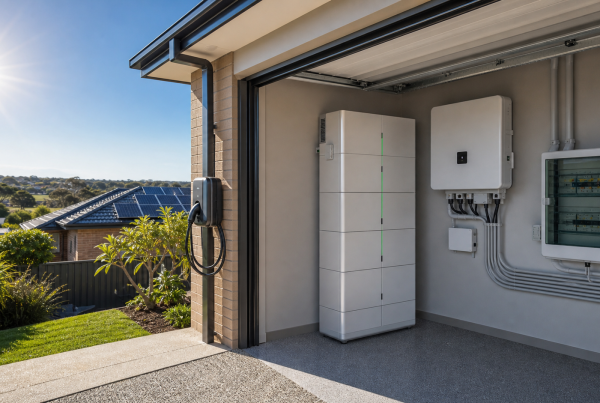
If you already have solar panels, you’re halfway to energy freedom. Adding a battery lets you keep the sun’s power for night‑time use, slash those evening electricity bills and keep the lights on when the grid goes down. With electricity prices jumping again this year and feed‑in tariffs paying just a few cents per kilowatt‑hour, it feels crazy to give your extra solar back to the grid for peanuts—then buy it back at dinner time for forty cents or more.
Right now, the NSW Government will even chip in up to about 25 to 30% through the Federal Home Battery rebate when you install an approved battery or hybrid inverter. Add that to the peace of mind of blackout protection, the boost to your home’s resale value, and the option to run an electric‑vehicle charger almost for free, and the maths starts to look pretty convincing.
In this guide we’ll show you the three most popular battery upgrade paths—Tesla Powerwall, modular Pylontech Force 3Hx, and the all‑in‑one Sigenergy SigenStor—so you can decide which one fits your family, your budget and your roof. Let’s dive in.
1. Audit Your Current System First
- Inverter age & warranty – units older than 8–10 years may be nearing end‑of‑life; replacement can be cheaper than patching.
- Phase type – single vs three‑phase affects battery size limits under AS/NZS 4777.2 (2020).
- DNSP export rules – Ausgrid & Essential Energy now ask for dynamic export control; your battery or new inverter must support it.
- Main switchboard space – batteries need isolators, generation meters and sometimes backup circuits.
- AS/NZS 5139 siting – high‑voltage batteries must clear habitable walls, windows and escape routes; sometimes a fire‑rated enclosure solves tight sites.
Tip: a quick site inspection and data‑logger download tells us if your home loads justify storage.
2. Three Proven Retrofit Pathways
2.1 Tesla Powerwall 2/3 – “Plug‑and‑Play” AC Coupling
- Type: all‑in‑one 13.5 kWh (PW 2) or 14.5 kWh (PW 3) pack with inbuilt battery inverter
- Compatibility: works with almost any grid‑tie inverter (Fronius, SMA, SolarEdge, Growatt, etc.)
- Key perks
- Keeps existing PV inverter (no roof DC rewiring)
- 10‑year unlimited‑cycle warranty, 90 % capacity retention.
- Black‑start backup via Gateway; powers selected circuits during outages
- Indicative installed cost (Newcastle): $13–15 k
- Best for: homeowners wanting the simplest, fastest install and whole‑home backup.
2.2 Pylontech Force 3Hx + New Hybrid Inverter – Scalable DC Coupling
- Type: high‑voltage stackable modules, 5.12 kWh each; 10.2 kWh to 20.5 kWh common stacks
- Hybrid partners: GoodWe EH/ET, Sungrow HV, Solis RHI, Fronius GEN24 (via BYD adaptor list)
- Why choose it
- Higher round‑trip efficiency (no double AC–DC conversion)
- Expand later by clipping another module to the tower
- 6000‑cycle, 10‑year warranty and IP55 outdoor rating
- What changes: your old PV inverter is replaced with a hybrid; DC strings plug straight into the new unit.
- Installed cost: It’s cheap! The batteries are priced very well so when you put more storage in, your cost actually comes down. The inverter is expensive to buy but the setup has been based to maximise inverter efficiencies. We really like this setp for consumers and the Force 3HX is proving to be a very popular battery. Newy Solar Co have been getting a-lot of inquiries about this solar battery in Newcastle.
- Best for: systems with ageing inverters or homeowners chasing maximum efficiency and larger capacities.
2.3 Sigenergy SigenStor – “All‑in‑One” Smart Energy Hub
- Type: modular tower containing a 5 kW/10 kW hybrid inverter, 5 kWh battery bricks (up to 48 kWh), integrated EV charger and AI optimiser.
- Unique extras
- IP66 aluminium chassis, <25 dB whisper‑quiet operation
- Built‑in diesel‑genset input for rural sites
- App‑driven AI that arbitrages tariffs and VPP events
- Installation notes
- Replaces existing inverter and meter isolators in a single tower footprint (approx. 460 mm height per module)
- Requires a 63 A main breaker to handle high‑power backup mode
- Indicative installed cost: $15–22 k for 10–15 kWh; economies of scale above 20 kWh
- Best for: tech‑enthusiasts wanting future‑proofed home energy plus EV charging in one package.
3. Network Approval, NSW Battery Rebates & VPPs
- Federal battery rebate is providing 25-30% off solar home batteries right now.
- SwitchDin droop control – Ausgrid zones east of the Hunter now mandate dynamic export ≤ 10 kW; all three options above comply.
- VPP earnings – Tesla Energy Plan historically pays $0.45–0.55 /kWh discharged during events; community VPPs via SolarHub or Amber can net $400 +/yr on 10 kWh.
- STCs vs LGCs – retrofits don’t attract additional STCs, but large Pylontech or Sigenergy stacks (>30 kWh) may register for secondary LGC revenue streams on Small Generation Aggregation platforms.
4. Step‑by‑Step Upgrade Process with Newy Solar Co
- Free 15‑minute battery readiness call – screenshot your inverter portal; we crunch the numbers.
- On‑site compliance audit & quote – $250 refundable on install.
- DNSP application & rebate paperwork – handled end‑to‑end by our CEC‑accredited team.
- Installation day (1 day for Powerwall, 1–2 days for hybrid swap) – we lodge the Electrical Work Request and AS/NZS 5139 compliance certificate.
- App walk‑through & VPP sign‑up – so you see savings from day one.
- 5‑year workmanship warranty + live monitoring portal – performance alerts straight to our service desk.
5. Frequently Asked Questions
Do I lose my existing feed‑in tariff?
No. Adding a battery doesn’t void premium PFIT/SFIT schemes; you’ll simply export less.
Can all three batteries provide whole‑home backup?
Yes—subject to main‑switchboard capacity. For larger houses (>15 kVA), splitting essential and non‑essential circuits keeps costs down.
What about three‑phase houses?
Powerwall 3 and Sigenergy towers natively support three‑phase backup; Pylontech stacks require a compatible three‑phase hybrid such as GoodWe ET 15 kW.
6. Conclusion
Upgrading from a daytime‑only solar system to 24‑hour solar‑plus‑storage is now easier—and more affordable—than ever. Whether you favour the set‑and‑forget Tesla Powerwall, the budget‑friendly, expandable Pylontech Force 3Hx, or the feature‑rich Sigenergy SigenStor, there’s a proven pathway to slash bills, protect against blackouts and boost your home’s value.
Ready to see which battery fits best?
👉 Book a free battery readiness check with Newy Solar Co today and start storing the sunshine you already own.