
Electroluminescence (EL) testing is a cutting-edge inspection method for solar photovoltaic (PV) panels. It allows us to “see” hidden cell damage the same way an X-ray reveals a hairline fracture. By using EL imaging, Newy Solar Co helps builders, installers, and insurers ensure every solar panel is healthy, safe, and performing optimally. This guide introduces what EL testing is, why it matters, and how it adds value in quality control, insurance claims, and long-term reliability.
What is EL Testing and Why Does It Matter?
EL testing involves making a solar module emit faint light (luminescence) by applying an electrical current in dark conditions. A special camera captures this light pattern. Healthy solar cells glow brightly, while defects like cracks or damage appear as dark areas (little or no light). In effect, EL imaging shows internal flaws that are invisible to the naked eye. This is why EL is often compared to an X-ray or MRI for solar panels – it reveals hidden problems before they cause power loss or safety issues.
Why it matters:
Solar panels can suffer damage (such as an impact from hail) that may not be caught by standard visual inspections, nor thermal photography. Micro-cracks, cell fractures, and other latent defects might not affect performance immediately, but over time they can spread or worsen. Such defects lead to reduced energy output and can even become hot spots (local overheating) – a potential fire risk. EL testing catches these issues early. By identifying hidden cell damage and the type of damage we can now attribute causation to a high degree.
How Does Electroluminescence Testing Work?
EL testing is a non-destructive field test that can be done on-site without uninstalling panels. Here’s how it works in practice:
- EL testing is a non-destructive field test that can be done on-site without uninstalling panels. Here’s how it works in practice:
- Dark Conditions: Testing is done at night or in a dark environment. This ensures the camera only sees the panel’s own faint glow and not sunlight.
- Biasing the Panel: We use a specialized power supply to inject a small electric current into the solar panel (forward bias). Essentially, we make the solar cells act like LED lights.
- Panels Glow, Camera Captures: As the current flows, healthy cells emit a dim infrared light. An EL camera (sensitive to this infrared luminescence) photographs the panel. Areas with defects emit less light, so they show up as dark spots or lines in the EL image.
- The result is a high-resolution “image” of the panel’s internal health (much like a medical scan)
- Analysis: Trained technicians examine the EL images to identify any anomalies. Dim or dark regions highlight issues like cracks or disconnected cell parts. We compare these against known patterns of defects. International guidelines ensure we interpret and classify these findings consistently and accurately.
The Difference Between Electroluminescence Testing and Thermal Testing
Electroluminescence Test of Solar Panels
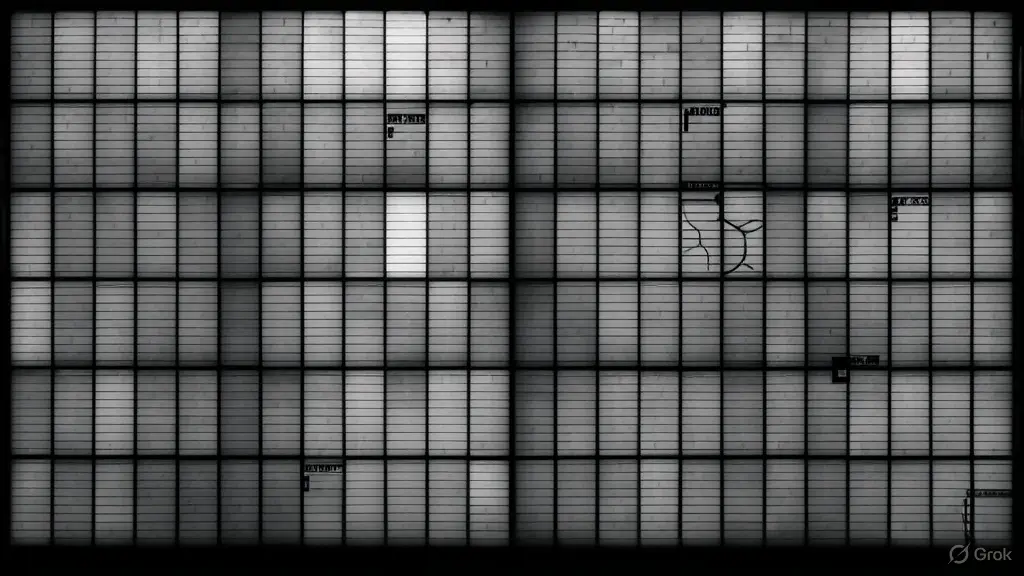
Solar panels which have undergone electroluminescence testing.
Thermal Test of Solar Panels
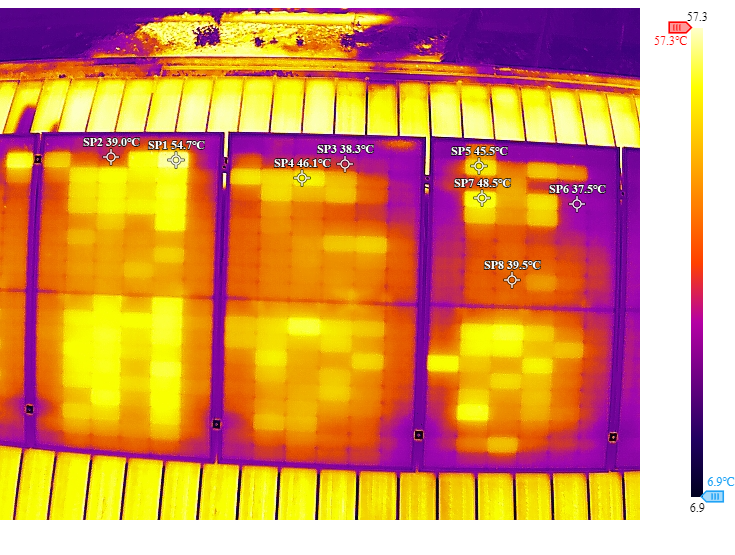
Solar panels which have undergone thermal testing.
Thermal Testing
What it is:
Thermal cameras use a thermal camera to detect temperature differentiation within a cell. From this we use recognised standards to apply a criteria for action and then we rationale the difference based on certain factors in order to attribute the cause and likelyhood of the damage.
It Reveals:
- If the cells are performing correctly
- Hotspots
- Areas of damage
Usefulness:
It’s quick and costs are reasonable as we can survey panels relatively quick if there is a power source active. However – sometimes we cannot attribute exact causation of the hotspots if there is data missing. This is where the benefit of EL shines.
Compared to EL Testing:
Thermal testing is a useful tool to see if there are any solar panels which are clearly damaged and the danger level of that damage – as the heat differentiation is used to apply a danger level classification. However, it is not 100% conclusive as thermal testing may miss certain defects and cracks caused by external events such as weather or hail which may have been caused but not sufficiently developed yet to cause significant temperature differentiation.
EL TESTING captures even the smallest microcrack or fault on a panel – regardless of heat – and you can conclusively see the damage caused on the panel.
Warranty Implications
Manufacturer’s Warranties may be Implicated
Many major manufacturers and suppliers of solar panels, state that warranties are no longer applicable after hail. Take Trina Solar Panels for example whom state;
This Global Limited Warranty does not apply to any Products which have been subject to:
Other acts beyond Trina Solar`s reasonable control (including direct or indirect damage by war, fire, flood, hurricane, volcanic eruption, surface collapse, debris flow, lightning, earthquake, heavy snowfall, hailstone, strong breeze etc.
Conclusion of Electroluminescence Testing
In order for consumers to maintain valid warranties after a hailstorm or as such the only way to prove that no damage has occurred is by conducting EL testing.
It is a new and emerging technology that not many people provide and the costs are relatively high considering as such.
However, it is the only conclusive way to determine exact damage that a solar panel has sustained after any event and it makes sense that the advent of EL testing is the next normal progression in testing technology after thermal testing, being more accurate.
For further information or to request testing contact NEWY SOLAR CO on 046-833-6370.
Director
Newy Solar Co Pty Ltd
CONTACT US for a solar inspection including Electroluminescence Testing in Newcastle, Maitland & the Hunter now.
Download the PDF HERE