As coal power stations retire across New South Wales, maintaining a stable electricity supply is a challenge. Large‑scale battery energy storage systems (BESS) are emerging as essential infrastructure to smooth out variability from wind and solar and to absorb shocks on the grid. Newcastle is at the heart of this transition thanks to two groundbreaking projects: the Waratah Super Battery near the Eraring power station and Ausgrid’s Steel River East BESS proposed in Mayfield West. This article dives into how these projects work, why they matter for residents and businesses in Newcastle, and how they complement solar batteries in Newcastle homes.
The Waratah Super Battery – a “shock absorber” for the grid
The Waratah Super Battery is one of the world’s largest battery projects. Located at the site of the former Lake Munmorah coal power station, the system has a planned capacity of 850 MW / 1 680 MWh, with at least 700 MW of active power and 1 400 MWh of usable storage. Its primary role is to act as a “shock absorber” for the NSW transmission network: when there are sudden disruptions (such as lightning strikes on transmission lines) or large fluctuations in generation, the battery will discharge or absorb energy to stabilise frequency and voltage.
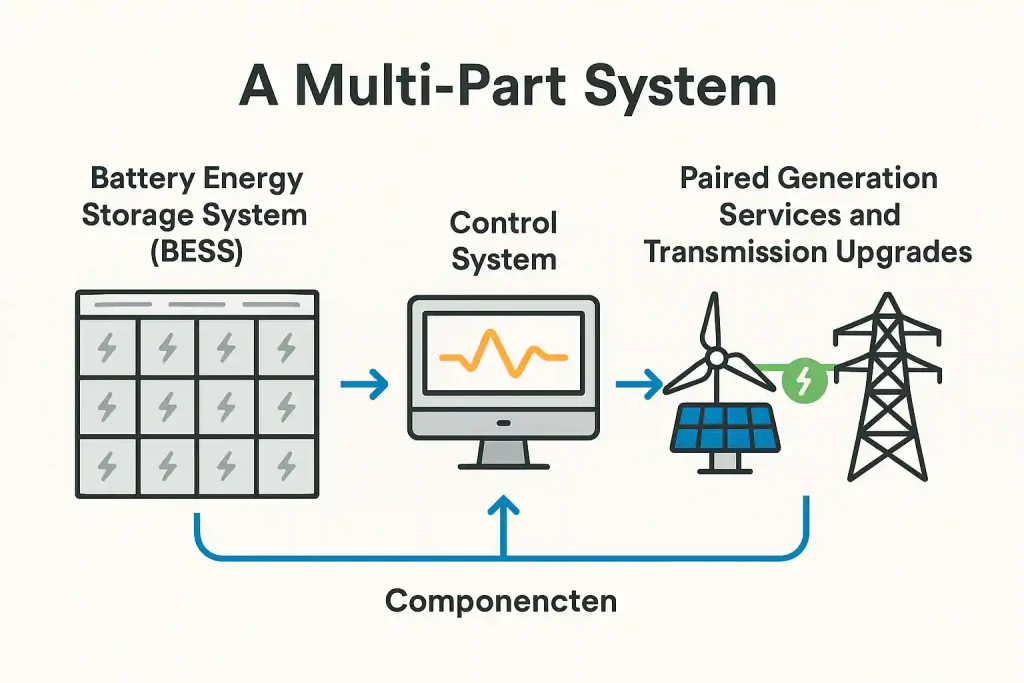
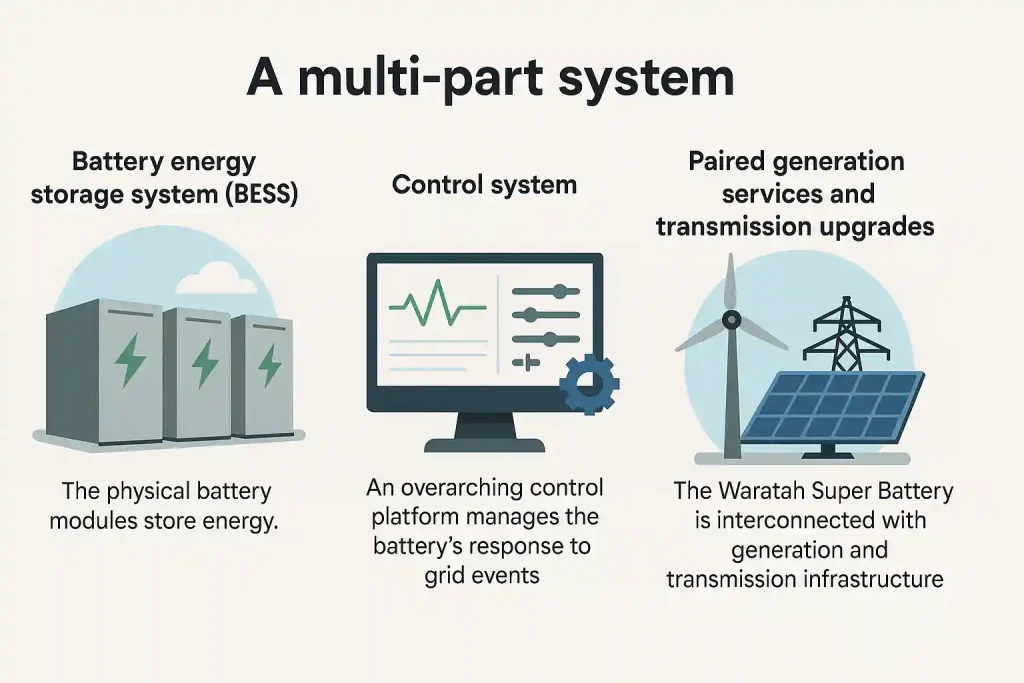
A multi‑part system
The Waratah Super Battery isn’t just a big battery pack. It comprises three key components:
- Battery energy storage system (BESS) – The physical battery modules store energy. With 1 680 MWh of capacity, the project can provide fast‑acting services over extended periods.
- Control system – An overarching control platform manages the battery’s response to grid events and coordinates with other infrastructure. This ensures the battery responds appropriately during frequency excursions and maintains grid stability.
- Paired generation services and transmission upgrades – To maximise benefits, the battery is paired with grid upgrades and generation services so it can charge when there is excess renewable generation and discharge during high demand.
Construction timeline and operation
Construction of the Waratah Super Battery began in May 2023 and physical installation was completed in October 2024. The battery entered partial operation in August 2025 and is expected to be fully operational by late 2025. It has been fast‑tracked to ensure reliability as the nearby Eraring coal power station prepares for closure.
Why it matters for Newcastle
Newcastle’s electricity grid is closely connected to the broader NSW network. When there are faults or generation shortfalls elsewhere, Newcastle can experience voltage drops or blackouts. The Waratah Super Battery acts as a buffer, absorbing sudden spikes or filling dips so that energy continues flowing to households and businesses. This improves reliability for consumers and enables more renewable energy to connect to the grid without compromising stability.
Ausgrid’s Steel River East BESS – boosting local resilience
While the Waratah Super Battery provides statewide support, Newcastle is also set to host its own large battery. Ausgrid has proposed a 200 MW / 400 MWh battery energy storage system at Steel River East in Mayfield West. This project will use Tesla Megapack 2XL units connected to the Mayfield West substation via a 33 kV underground cable.
Each Megapack 2XL stores 15.6 MWh of energy and provides 3.9 MW of power, with a round‑trip efficiency of 87 % and an expected lifespan of 50 years. By clustering multiple units, Ausgrid can scale up the project to deliver hundreds of megawatts of fast‑responding storage.
Facilitating the energy transition
Ausgrid’s project is part of a broader strategy to facilitate more than 1.5 GW of distribution‑connected storage by the early 2030s. By placing batteries in the distribution network (closer to consumers), Ausgrid can defer expensive grid upgrades, manage local peaks and support rooftop solar exports. The Steel River East BESS will also enhance resilience by providing backup power during outages and participating in virtual power plants that aggregate many distributed resources.
Land use and community benefits
One advantage of the Steel River East project is that it utilises existing industrial land near an existing substation. This reduces the need for new transmission corridors and minimises impacts on sensitive ecosystems. The battery will operate silently and produce no emissions during operation. Importantly for the community, it will support local jobs during construction and ongoing maintenance, while improving power quality and reliability for nearby suburbs.
How grid‑scale batteries complement home storage
Some people might wonder whether large batteries make household batteries redundant. In reality, the two technologies are complementary.
Strengthening the grid for everyone
Grid‑scale batteries provide system‑level services such as frequency control, contingency reserve and network stability. They allow more rooftop solar to connect without causing voltage swings or requiring costly network upgrades. By reducing peak demand and smoothing supply, they help lower wholesale electricity prices and benefit all consumers, even those without solar or batteries.
Empowering households and businesses
Household batteries, on the other hand, provide behind‑the‑meter benefits. They maximise self‑consumption of solar, reduce reliance on the grid and provide backup during outages. With the Cheaper Home Batteries Program (see our separate article for details), households can now access generous discounts for batteries between 5 kWh and 100 kWh. These systems will work in concert with grid‑scale batteries: when many homes discharge into the grid during the evening, large batteries can coordinate and amplify that response, further stabilising the network.
Participating in virtual power plants (VPPs)
Both large and small batteries can participate in virtual power plants, which aggregate multiple units and dispatch them as a single resource. VPPs allow households to earn additional revenue by selling stored energy or providing grid services. As part of its bulk‑buy program, the City of Newcastle plans to educate residents about joining VPPs and connecting batteries into community energy networks. This creates new income streams for battery owners while strengthening local resilience.
Supporting the transition away from coal
New South Wales is phasing out ageing coal power stations, which have provided baseload energy for decades. Batteries provide fast, flexible capacity that can fill gaps left by retiring coal units. Unlike gas peaker plants, batteries can respond in milliseconds and don’t produce emissions. The Waratah Super Battery and Steel River East BESS demonstrate that Newcastle is proactively investing in cleaner, more responsive infrastructure.
Economic benefits for Newcastle
Large‑scale battery projects also deliver economic benefits. Construction and maintenance create local employment opportunities, often using electricians and engineers from the region. Strengthened grid reliability can attract new industries – particularly those with high sensitivity to power quality, such as data centres and manufacturing. Moreover, by integrating more renewable energy and reducing network constraints, batteries can help lower wholesale electricity prices, benefiting households and businesses.
Community engagement and environmental considerations
Battery projects must consider community views and environmental impacts. Both the Waratah and Steel River East projects include community consultation, noise and visual impact assessments and environmental approvals. Because battery systems have a small physical footprint and no smokestacks, they can often be co‑located with existing infrastructure. Recycling and end‑of‑life management are also planned in collaboration with government recycling initiatives.
Looking ahead
The Waratah Super Battery is only the beginning. Across Australia, more than 27 large‑scale batteries were under construction at the end of 2023 for a combined capacity of 5 GW / 11 GWh, up from 1.4 GW / 2 GWh in 2022. Many of these projects will connect to distribution networks like Ausgrid’s, enhancing local reliability and supporting the growth of rooftop solar and electric vehicles.
As battery costs fall and government incentives expand, households will also play a larger role. In 2024, Australians installed 74 582 household batteries, but this number is expected to surge with the Cheaper Home Batteries Program. Coordinating the output of these small batteries with large grid‑scale systems through VPPs will be crucial to achieving a resilient, low‑carbon grid.
What it means for you
For Newcastle residents, these developments mean greater energy security, lower bills and more opportunities to participate in the renewable transition. By installing a home battery today, you not only reduce your own energy costs but also contribute to a smarter, cleaner network.
How Newy Solar Co. can help
Newy Solar Co. is a locally owned company specialising in rooftop solar and battery installations. We are accredited to supply and install systems eligible for the Cheaper Home Batteries Program and we closely monitor developments at the grid level. Our experts can help you design a battery system that meets your needs, integrates with virtual power plant programs and complements the large‑scale projects reshaping Newcastle’s grid.
Call to action
Want to be part of Newcastle’s clean energy future? Visit our battery solutions page or contact us for a free consultation. Let’s work together to store your sunshine and build a more resilient community.