By Newy Solar Co Pty Ltd – local solar installer Newcastle, Lake Macquarie & Hunter Valley. Call 0468 336 370 for a tailored quote or contact here. This blog is about solar battery backup in Newcastle and the difference between a full home backup and a partial backup system, and how to decide which one is best for you. Why Backup Choice Matters

Storms, planned Ausgrid works and summer bush-fire outages are familiar across Newcastle, Lake Macquarie and the Hunter. With the 2025 Federal Solar Battery Rebate offering up to 30 % off storage systems[1], more households are asking whether to wire their new battery for whole-home backup or partial (essential-load) backup when we install solar and batteries in Newcastle for them. This guide explains both options, costs, and how you can decide which circuits stay live during a blackout.
What Is Whole-Home Battery Backup?
A whole-home system battery backup is wired so the battery and hybrid inverter power all switchboard circuits when the grid fails. Your house operates almost normally, but the battery must cover peak loads like air-con, oven or pool pump. There are pros and cons to this system.
Pros
- Ultimate convenience: occupants may not notice an outage.
- Simpler wiring: fewer circuits to re-route; entire MSB stays intact.
- Market appeal: full-backup homes can command higher resale value.[2]
Cons
- Higher upfront cost: needs larger inverter (≥8 kW) and bigger battery (≥16 kWh) to handle whole-house demand.
- Risk of overload: if high-draw appliances run simultaneously during blackout, the system can trip. Smart load-shedding (Sigenergy SMART Load, Sungrow ATS) is advised.
- Shorter runtime: running everything drains storage faster.
What Is Partial (Essential-Load) Backup?
Partial backup isolates a dedicated sub-board or splits up the circuits in your main switchboard fed from the inverter’s EPS or Backup port. Only essential circuits (e.g. fridge, some lights, phone chargers, garage door) receive battery power in an outage. Basically, you want to out the bare bones on these circuits. You want to be able to see so you put lights, you want general power points working and you may want some kitchen appliances going like the fridge, microwave etc. When a house looses power, it is not a priority to run a pool pump – so these things are left off the backup circuits.
Pros
- Lower upfront cost: A10 kWh battery often covers essentials.
- Longer blackout runtime: fewer loads drain energy slowly – great for multi-day storms.
- Easier on wiring safety: heavy circuits (oven, EV charger) remain offline, preventing inverter overload.
Cons
- Extra switchboard work: essential circuits must be moved to a backup sub-board or gateway port.
- Some appliances unusable: hot water, cooktop, ducted AC stay off until grid returns.
- User confusion: occupants must know which power points stay live.
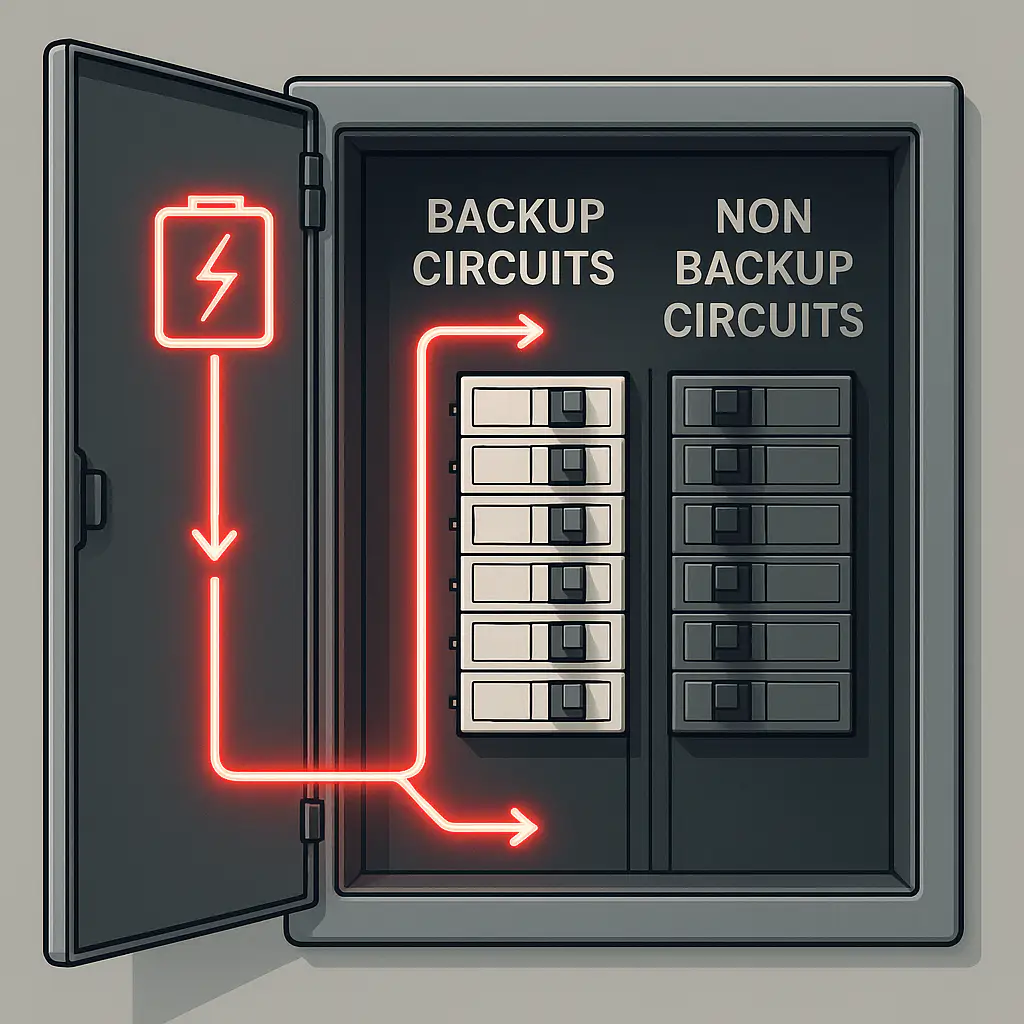
This image shows a simple depiction of how it works in your switchboard. In an ‘essential’ only backup, only part of your switchboard will remain live.
Circuits like general power and lights are the main ones to consider for your Battery Backup in Newcastle.
Who Chooses the Backup Circuits?
Your battery system does not automatically select circuits. During installation, the licenced electrician and homeowner agree which breakers move onto the EPS/backup bus. Popular choices are fridge, modem, some lights, garage door and a couple of power points. Heavy loads (oven, ducted A/C, EV charger) usually stay on the normal grid side unless you size the battery large enough to handle them.
Option 1 – Whole-Home Backup
A whole-home design (e.g. Tesla Powerwall 3 + Gateway 3 or Sigenergy SigenStor + Sigen Gateway) powers every breaker in the switchboard when the grid fails.
Pros
- Seamless living – family may not notice the outage.
- Simpler wiring – no sub-board shuffling.
- Property value boost – full-backup homes rank higher on real-estate listings[2].
Cons
- Bigger spend – needs ≥13 kWh battery and ≥8 kW hybrid inverter.
- Runtime risk – running oven + A/C can flatten the battery fast.
- May need smart load shedding – brands like Sigenergy offer “Smart Load” ports to drop the hot-water circuit automatically.
Option 2 – Partial (Essential-Load) Backup
Partial backup moves selected circuits to a backup sub-board or dedicated gateway port (Tesla ‘Backup-Only’ mode, Sungrow hybrid + ATS, Fronius GEN24 with PV Point).
Pros
- Lower cost – 5–10 kWh battery often covers essentials.
- Longer blackout runtime – fridge + Wi-Fi can run all night.
- Expandable – start with one battery; add more later.
Cons
- Extra switchboard labour to split circuits.
- Non-essential appliances off until grid returns.
- Family must know which GPOs stay live (we can help with this)

During the day, when the grid is out the inverter will ‘island’ itself from the grid. This is termed a ‘backup’ or Hybrid inverter as it can work both on and off the grid. Here, the system still works despite the grid being out and the power lines down.
Cost Snapshot – Newcastle 2025 (post-rebate)
| Scenario | Battery (kWh) | Upfront Cost* | Federal Rebate | Net Cost |
|---|---|---|---|---|
| Partial-backup | 8 | $12,200 | $2,976 | $9,224 |
| Whole-home | 13.5 | $17,800 | $5,022 | $12,778 |
*Average quote from solar installer Newcastle network; includes inverter, gateway & CEC accredited install.
Runtime Estimates (Typical Hunter Usage)
- 8 kWh partial – 10–12 hours essentials.
- 13.5 kWh whole-home – 4–6 hours normal use.
- 24 kWh whole-home – 9–12 hours normal use or 2–3 days essentials.
Decision Checklist
Choose whole-home backup if …
- You want “lights-on” convenience for every circuit.
- You run medical devices or work-from-home servers.
- You’re happy to invest in a larger battery (> 20 kWh stack or dual Tesla Powerwall 3).
Choose partial backup if …
- Budget or payback period is a priority.
- Your main goal is keeping fridge, lights and internet alive.
- You plan to expand storage later when prices drop.
BUT: Sometimes customers choose whole home backup and state they will simply not run air con and heavy appliances during an outage. The thing is, due to the seamless change over of the battery systems during an outage, sometimes the customers don’t realise they are even in a blackout – and end up draining their battery.
Local Rebates & Safety Rules
- Federal “Cheaper Home Batteries” rebate: ~$372 /kWh off first 50 kWh from 1 July 2025[1].
- NSW Peak Demand Reduction Scheme offers point credits for eligible batteries (cannot stack with federal rebate on same unit)[3].
- Install standard: All solar battery installers Newcastle must comply with AS/NZS 5139 and hold CEC Battery Endorsement.
Brands We Install
- Tesla Powerwall 3 – 11.5 kW peak, seamless whole-home backup.
- Sigenergy SigenStor – Modular 5 kWh blocks, Smart-Load port for hot-water shedding.
- Sungrow SH10RS – 10 kW hybrid inverter with automatic transfer switch for partial backup.
Get Expert Guidance from Newy Solar Co
Every house is different. Our solar battery installers at Newcastle, Lake Macquarie to Maitland will model your load profile, design the switchboard split, and claim your rebate paperwork. If you are looking for a competent and trustworthy Newcastle Solar Installer for your Solar Battery Backup system in Newcastle, call us below.
☎ 0468 336 370 – Speak to Newcastle’s trusted solar installer today.
References
- Commonwealth Dept. of Climate Change – Cheaper Home Batteries Program Factsheet, 2025.
- CoreLogic Property Monitor – Solar & Battery Premium on NSW House Prices, 2024.
- Energy Saver NSW – Peak Demand Reduction Scheme Battery Credits Guide, 2024.