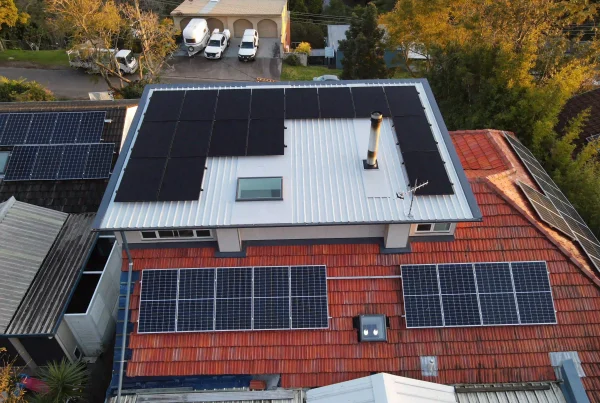
Solar power has become a cornerstone of renewable energy solutions in Newcastle, Lake Macquarie, and Maitland. Yet not all solar installations are created equal. While the classic approach of pointing panels north often yields the highest theoretical energy output on paper, many homeowners and businesses find that a dual orientation—with half the panels facing East (E) and the other half facing West (W) aka ‘East West Solar Power Arrays’ —can optimize actual savings and align production with daily energy usage. This is known as an E W solar array or East West Solar Orientation.
Throughout this blog post, we’ll explore:
- What an E/W solar array actually is and why it’s growing in popularity.
- Why families who use more power in the morning and evening can see greater cost savings—despite a modest drop in total kilowatt-hour (kWh) production.
- Realistic financial calculations for a typical 10 kW rooftop solar system in Newcastle, using $0.35/kWh for retail power and $0.04/kWh feed-in tariffs.
- Long-term considerations like batteries, solar maintenance, and system servicing that solidify the E W array’s value for local homeowners.
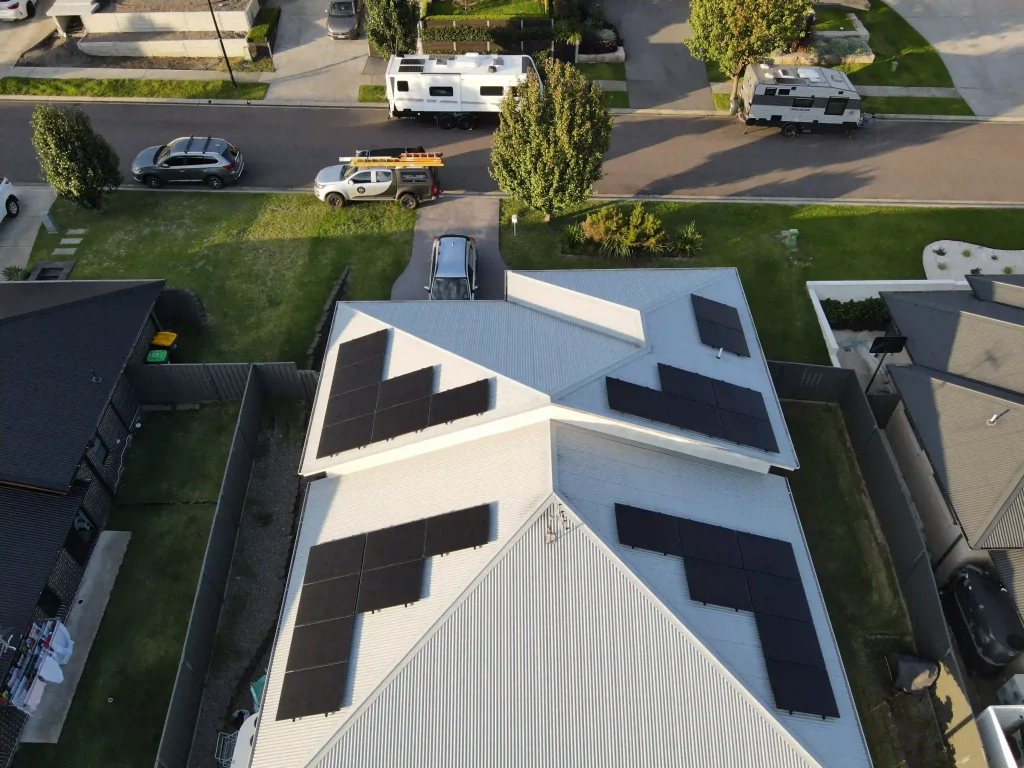
This is a picture of one of our perfect East West Solar arrays. This picture was taken right before the sunset. Notice how the eastern side is shaded as well as the north side but the western side is receiving the very last filters of light. This mean the customer is getting solar power right until the sun goes down.
1. Understanding the E W Solar Array Concept
North-Facing vs. East/West-Facing
Traditionally, north-facing panels in Australia receive the most direct midday sunlight, achieving a single large production peak at around noon. However, for a home that’s empty during this period (when most people are at work or school), midday solar production can be “wasted” and exported to the grid at a low feed-in tariff (often just $0.03–$0.05/kWh).
By contrast, an E W solar array divides the panels into two sets:
- East-Facing Panels: These capture strong morning light, providing power during breakfast time, morning showers, and any early office or school prep.
- West-Facing Panels: These deliver a second boost of energy in the late afternoon and early evening, covering that 4–7 PM window when the family is back home, cooking dinner, running dishwashers, or watching TV.
The morning and afternoon peaks often line up much better with real usage patterns in many Australian households, which can push self-consumption up substantially.
Why “Less Total kWh” Sometimes Means More Value
Because neither east nor west is ideal at noon (when the sun is directly overhead in summer or slightly north in winter), E W arrays typically produce about 90–95% of the total kilowatt-hours that a purely north-facing array might. However, what matters most to your electricity bill is how many of those kilowatt-hours you use in your home—offsetting the $0.35/kWh retail rate—versus how many you export for just $0.04/kWh. An E W array often has lower exports and higher on-site usage, which can boost your daily dollar savings.
This phenomenon—where a smaller total generation can lead to bigger savings—has been examined and many homeowners discover that “chasing the highest kWh” (by going north) doesn’t necessarily mean “chasing the highest ROI,” especially when the feed-in rate is a fraction of the retail tariff.
2. Realistic Calculations for a Newcastle 10 kW System
To illustrate the advantage of an E W split, let’s consider a 10 kW rooftop solar system. These calculations are approximations—but grounded in actual data from the APVI Solar Map (Australian PV Institute), which tracks real performance across different Australian regions, and typical insights for the Newcastle climate.
2.1 System Assumptions
- Location: Newcastle, NSW
- System Size: 10 kW (DC)
- Retail Electricity Rate: $0.35/kWh (the approximate flat rate many providers charge in 2023–2025)
- Feed-In Tariff (FiT): $0.04/kWh (typical in NSW, though it can range from 3–5 c)
- Household Daily Usage: 25 kWh (with heavier usage in morning/evening)
2.2 North-Facing Array Production
A well-installed, unshaded north-facing system in Newcastle might yield around 40 kWh on a clear day:
- Morning (6–10 AM): 8 kWh
- Midday (10 AM–2 PM): 20 kWh
- Afternoon (2–6 PM): 12 kWh
Total = 40 kWh
2.3 E W Split Array Production
An E W split typically yields about 90–95% of the energy of a north array. For simplicity, we’ll assume 36 kWh total, broken down as:
- East Side (6–10 AM): 12 kWh
- Midday (10 AM–2 PM): 6 kWh
- West Side (2–6 PM): 18 kWh
Total = 36 kWh
3. Matching Production to Consumption
Let’s assume a family uses:
- 12 kWh in the morning (6–10 AM)
- 3 kWh midday (10 AM–2 PM)
- 10 kWh late afternoon/evening (2–6 PM)
3.1 North-Facing Array Financials
- Morning:
- Produced: 8 kWh
- Consumed: 12 kWh
- Self-Consumption = 8 kWh
- Grid Purchase = 4 kWh
- Midday:
- Produced: 20 kWh
- Consumed: 3 kWh
- Self-Consumption = 3 kWh
- Export = 17 kWh
- Afternoon/Evening:
- Produced: 12 kWh
- Consumed: 10 kWh
- Self-Consumption = 10 kWh
- Export = 2 kWh
Totals:
- Self-Consumed: 8 + 3 + 10 = 21 kWh
- Exported: 19 kWh (40 – 21)
Value:
- Self-Consumption Savings: 21 kWh × $0.35 = $7.35/day
- Feed-In Revenue: 19 kWh × $0.04 = $0.76/day
- Total = $8.11/day
3.2 E W Split Array Financials
- Morning (East):
- Produced: 12 kWh
- Consumed: 12 kWh
- Self-Consumption = 12 kWh
- Midday:
- Produced: 6 kWh
- Consumed: 3 kWh
- Self-Consumption = 3 kWh
- Export = 3 kWh
- Afternoon (West):
- Produced: 18 kWh
- Consumed: 10 kWh
- Self-Consumption = 10 kWh
- Export = 8 kWh
Totals:
- Self-Consumed: 12 + 3 + 10 = 25 kWh
- Exported: 11 kWh (36 – 25)
Value:
- Self-Consumption Savings: 25 kWh × $0.35 = $8.75/day
- Feed-In Revenue: 11 kWh × $0.04 = $0.44/day
- Total = $9.19/day
3.3 Head-to-Head Comparison
| Parameter | North-Facing (10 kW) | E W Split (10 kW) |
|---|---|---|
| Daily Yield (kWh) | 40 | 36 |
| Morning Production (kWh) | 8 | 12 |
| Midday Production (kWh) | 20 | 6 |
| Afternoon Production (kWh) | 12 | 18 |
| Self-Consumption (kWh) | 21 | 25 |
| Exported (kWh) | 19 | 11 |
| Daily Savings ($) | $7.35 | $8.75 |
| Feed-In Revenue ($) | $0.76 | $0.44 |
| Total Value ($/day) | ~$8.11/day | ~$9.19/day |
Over a year (roughly 365 days), this difference of $1.08/day adds up to $394 extra in savings—purely by splitting the orientation so morning and evening consumption is covered. While not enormous, it’s significant for many families—and it’s also more stable, since it aligns with typical usage patterns rather than chasing midday peaks. Over the life of the inverter – it translates to around $4000 in savings (10 years) – or free car rego every year!
4. Why E W Suits Newcastle, Lake Macquarie & Maitland
4.1 Lifestyle Patterns
Many families in Newcastle and surrounding areas have early-morning routines and get home mid- to late-afternoon, leaving midday as a low-consumption window. That’s precisely when a north-facing array would produce the most power—but it may mostly be exported at $0.04/kWh. By reducing midday production and boosting morning/afternoon yields, the E W solar array improves self-consumption and energy production optimization.
4.2 Seasonal Effects
- Summer: The sun is high, so even east- and west-facing panels capture plenty of energy in Newcastle’s long, bright days.
- Winter: The difference between east, north, and west is less pronounced because the sun is lower on the horizon overall—but those morning and afternoon gains can still help offset heating and lighting during the shorter days.
4.3 Grid Stability & Future Tariffs
As more solar systems come online, midday generation surges. Energy companies may further reduce midday feed-in rates in the future—making north-facing midday surpluses less lucrative. An E W setup, by spreading out production, can help hedge against future tariff changes.
5. Practical Tips for Installation & Maintenance
5.1 Working with Local Experts
Finding a Solar Installer Newcastle or Lake Macquarie Solar Installer with experience in E W arrays is key. They’ll:
- Perform a site assessment to ensure shading is minimal for east- and west-oriented panels.
- Design an array that balances each side effectively.
- Advise on Solar Inverter Integration—some inverters have dual MPPT (Maximum Power Point Tracking) inputs that are perfect for an E W split.
For homeowners in Maitland, the same approach applies: look for a Maitland Solar Installer with proven PV system design skills who can confirm your roof is suitable for dual orientation.
5.2 Regular Solar Maintenance
All solar systems require some maintenance to operate optimally:
- Cleaning: Dust, bird droppings, or pollen can accumulate on panels. Because an E W system might have a lower tilt or be installed across multiple roof sections, professional cleaning is often safer and more thorough.
- Inspection: A Solar Maintenance Newcastle professional can spot issues like degraded wiring, water ingress, or storm damage.
- Rectification: If you see dips in production, an expert in Solar Rectification Newcastle can diagnose and fix problems—be it a faulty isolator, loose connector, or inverter glitch.
- Monitoring: Many inverters now come with smart monitoring. This data helps you track daily production and compare it to expected yields for each orientation.
5.3 Servicing & Warranty
Reputable Newcastle Solar Power Installer companies often offer extended warranties on panels, inverters, and workmanship. To keep those warranties valid, abide by recommended servicing intervals and conditions. Sometimes an annual or biennial check is enough, but those checks can prevent small issues from spiraling into expensive repairs.
6. Future-Proofing: Batteries & Smart Homes
6.1 Battery Integration
The next big step in renewable energy solutions is combining rooftop solar with home battery storage:
- Morning Production: If your battery is partially depleted overnight, those early eastern panels can help recharge it.
- Afternoon/Evening: Western panels might top off the battery before the sun sets—offering free electricity during prime-time hours.
In an E W design, you get a “wider funnel” of daily solar input, making it easier to fill the battery before bedtime. While battery economics still vary, Advanced Solar Technology is driving down costs each year.
6.2 Smart Home Systems
Pairing an E W solar array with a smart home approach—running dishwashers, washing machines, or pool pumps when your array is generating best—can further lift self-consumption. Tools like timer-based or Wi-Fi-enabled appliances let you harness midday sun (when you do have some west- or east-oriented generation). By actively shaping consumption to match solar supply, you can stretch the benefits of your dual orientation solar panels even more.
7. The Big Picture: Environmental & Grid Benefits
Beyond the financial angle, E W arrays can help flatten the solar curve from a grid standpoint. If everyone installed purely north-facing panels, the network would be flooded with midday solar and see shortfalls in early morning and evening. By distributing generation, E W systems reduce some of the stress on local infrastructure, making sustainable solar installations more grid-friendly overall.
This aligns with the CEC’s broader push for optimal solar performance and energy storage to stabilize local grids, especially as Newcastle’s solar adoption rate climbs. As feed-in tariffs fluctuate, systems that naturally produce power throughout the day (rather than all at once) have an inherent advantage both for the homeowner and for the broader community.
8. Common Questions & Misconceptions
8.1 “Aren’t North-Facing Systems Always Best?”
They are often “best” for maximizing total production in ideal, unobstructed conditions. However, if you aren’t there to use that midday power, you’re forced to export more. With FiT rates like $0.04/kWh (and retail at $0.35/kWh), that’s a poor trade. Many families see better real-world returns with E W because the generation lines up with their usage times.
8.2 “Will an E W Split Provide Enough Power Midday?”
For moderate midday loads—like a fridge or a small air conditioner—the 6 kWh output from the combined east/west panels around noon is often sufficient. If midday usage is huge (e.g., a heavy-duty workshop or high-powered air-conditioning), partial or fully north-facing arrays might still be worth considering—or simply install more total wattage if roof space allows.
8.3 “Does E W Increase Panel Degradation?”
No. Panel degradation rates primarily depend on quality (e.g., Tier 1 vs. lower-tier panels) and environmental stresses such as heat, UV exposure, and physical damage. Facing East or West doesn’t inherently degrade panels faster than North or even tilting them. For the best lifespan, maintain them properly and ensure the Solar Inverter Integration is done by professionals.
9. When North-Facing Could Still Win
An E W solar array isn’t a silver bullet for everyone. In some scenarios, a purely north-facing design might be more suitable:
- Constant Daytime Loads: If a business or large household runs heavy loads at midday—such as big industrial machines, commercial refrigeration, or continuous air conditioning—north might yield better synergy with usage.
- Limited Roof Space: If you only have enough space in one orientation—say, a small north roof and shaded east/west sections—then you may not have the option for a dual orientation.
- High Feed-In Tariffs: If you happen to secure a legacy or premium feed-in tariff (sometimes 10–20 c/kWh from older deals), exporting more power at midday can still be profitable. But those high FiTs are increasingly rare.
In short, you should always balance your household’s load profile, roof geometry, and future energy needs. A Solar Installer Newcastle with proven PV system design expertise can evaluate shading, tilt angles, orientation, and your usage patterns to decide what’s truly “optimal.”
10. Getting Started: Choosing an E W Solar Array in Newcastle
If you’re considering an E W solar array for your Newcastle, Lake Macquarie, or Maitland property, here’s how to begin:
- Assess Your Roof: Does it have clear east/west pitches with limited shading? Taking photos or using online solar roof tools can offer a preliminary check.
- Find a Local Expert: Seek out a Newcastle Solar Power Installer or Lake Macquarie Solar Installer who explicitly mentions dual orientation or E W expertise in their portfolio.
- Review Past Bills: Look at your daily usage patterns if you have a smart meter. Morning and evening spikes? An E W design is likely beneficial.
- Request a Custom Quote: Have the installer do a site-specific calculation. They can show predicted yield for both a north system vs. an E W approach—along with financial payback timelines.
- Check Maintenance & Warranties: Reputable providers also offer or arrange Solar Maintenance Newcastle, Solar Servicing Newcastle, and Solar Rectification Newcastle. This ensures you have a backup if something goes wrong.
11. Long-Term Gains: More Than Just Immediate Savings
11.1 Encouraging Self-Reliance
As more Australians adopt solar, grid operators in NSW may continue adjusting tariffs, limiting midday export capacity or reducing FiTs. By producing solar power when your household actually needs it, you become more self-reliant and less subject to those external changes.
11.2 Battery-Ready Approach
Many E W system owners eventually add batteries to capture any leftover morning or afternoon surplus. By storing energy for evening or nighttime usage, homeowners cut grid reliance even further. The synergy of E W + battery storage can help households approach partial or near-complete independence from grid power.
11.3 Community-Wide Impacts
Beyond personal savings, E W splits can help flatten the “duck curve” phenomenon—reducing midday overproduction and bridging morning/evening gaps. As described in CEC reports, balanced generation is beneficial for overall Newcastle renewable energy grid stability, especially as more households transition to solar.
12. Final Word: E W Arrays for Financial & Practical Wins
The E W solar array concept boils down to a smart match of energy production with consumption patterns. Rather than chasing the absolute maximum kWh at midday, you shift some capacity to the times you’re actually home and using power—mornings and afternoons/evenings. For a family that’s out midday, this can turn a “theoretically less optimal” orientation into a real-world winner in financial terms.
Here in Newcastle, Lake Macquarie, and Maitland, the difference between buying power at $0.35/kWh and selling it at $0.04/kWh is simply too large to ignore. By upping your self-consumption from, say, 21 kWh/day to 25 kWh/day (as we saw in our example), you can noticeably improve the overall ROI on your solar system—often outstripping the theoretical gains of a north-facing approach.
Key Takeaways
- Installers Matter: Choose a Solar Installer Newcastle or Maitland Solar Installer who understands your roof, your consumption, and your local conditions.
- Maintenance & Monitoring: Keep the system healthy with Solar Maintenance Newcastle and Solar Servicing Newcastle to maintain high solar panel efficiency.
- Financial Sense: If your morning and evening demand is significant, an E W array likely boosts daily savings—despite a slightly smaller total yield.
- Future-Proofing: If you plan to add a battery or EV charger later, morning and evening solar production can pair well with those technologies.
Final Thoughts
Embracing an E W solar array in Newcastle (and throughout Lake Macquarie or Maitland) can make excellent sense—especially under current electricity rates. By maximizing self-consumption and reducing low-value exports, you tailor your solar production to real household rhythms. It’s a shift from chasing the absolute highest midday kilowatt-hour total to optimizing morning and late-afternoon coverage—often yielding better financial returns and a more comfortable match to your daily life.
So, if your home stands idle from 9 AM to 3 PM, consider splitting your panels East and West. Engage a Solar Installer Newcastle with proven success in PV system design for dual orientations. From there, keep it all running smoothly with Solar Maintenance Newcastle or Solar Servicing. Whether you’re new to solar or looking to upgrade an existing system, an E W solar array may just be the advanced solar technology solution you’ve been waiting for—delivering optimal solar performance, increased energy yield (where it counts), and a sustainable path for both your wallet and the planet.