Solar Batteries Newcastle: Sizing, Technology & Costs
A home battery system lets you store the sunshine that hits your roof and use it whenever you need it. In Newcastle and the Hunter Valley – where households consume around 20 kWh per day – the right battery can keep your lights on during outages, slash peak‑hour bills and give you control over rising electricity prices. With solar batteries Newcastle now receiving generous federal and NSW incentives and feed‑in tariffs heading south, there has never been a better time to add storage to your rooftop solar.
This guide explains how to size a battery, compares the main technologies and brands, and breaks down rebate programs and installation rules so you can make an informed decision. If you already have solar panels, our battery retrofit blog shows how to upgrade. For those still on the fence about solar, read why delaying solar costs money to see how quickly pay‑backs can shrink.
Why Consider Solar Batteries in Newcastle
Newcastle enjoys more than 4.5 hours of peak sun per day, which translates into a lot of unused energy without storage. Here’s why batteries make sense in our region:
- Maximise self‑consumption – Battery storage lets you use cheap solar energy at night and during peak tariff windows instead of exporting excess generation for a few cents per kilowatt‑hour.energy.gov.au
- Reduce grid dependence – During evening peak periods, wholesale prices can reach 30–60 ¢/kWh. By storing energy midday you avoid paying these high rates and protect yourself from rate spikes.
- Backup for outages – Newcastle’s storms occasionally knock out grid power. A properly designed system can keep critical circuits – such as fridges, lights and Wi‑Fi – running for hours.
- Unlock rebates – From 1 July 2025 the federal Cheaper Home Batteries Program offers around a 30 % discount on the installed cost of an eligible small‑scale batteryenergy.gov.au. NSW also pays up to $1 500 to households and businesses that connect their battery to a virtual power plant (VPP)energy.nsw.gov.au. Combined, these incentives can trim nearly $5 000 off an 11.5 kWh batteryenergy.nsw.gov.au.

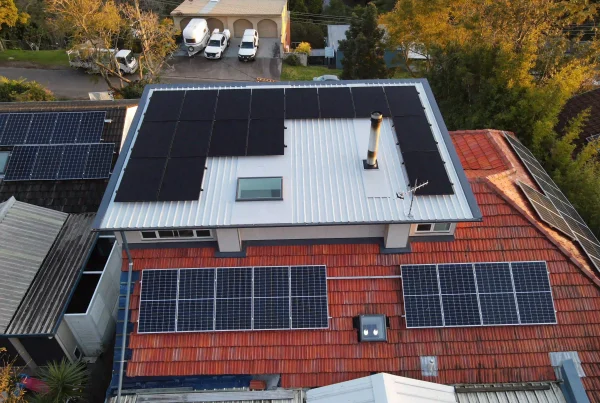
Alt text: modern Australian home with solar panels and a wall‑mounted solar battery, sunset – solar batteries Newcastle
Choosing the Right Battery Size
The “right” battery size depends on how much energy you use, when you use it and whether you want whole‑home backup or just to shave peaks. Here’s a simple framework to get started:
1. Analyse your usage
Download your electricity bill or log into your inverter portal to see your daily consumption (kWh) and your solar export profile. If you use 20 kWh/day and your solar covers 70 %, you still import about 6 kWh/day – often during the evening. A battery that can cover this import plus a little extra for outage protection is ideal.
2. Match discharge capacity to evening loads
Batteries are rated by usable kilowatt‑hours (kWh). For most Newcastle households:
- 5–7 kWh batteries handle small evening loads (lights, TV, fridge) but may run out before morning.
- 10 kWh units cover a typical three‑bedroom home from sunset to bedtime.
- 13–15 kWh batteries (e.g. Tesla Powerwall 2/3) provide whole‑home backup and run larger appliances like air conditioners or pool pumps.
- 20+ kWh systems suit large houses, all‑electric homes, or families with electric vehicles.
3. Consider expansion
Modular batteries like Pylontech Force 3Hx and Sigenergy SigenStor allow you to start with 10 kWh and clip on extra modules later. This future‑proofs your investment as your energy use changes (e.g. you buy an EV or electrify hot water).
4. Plan for backup power
If outage protection is a priority, choose a battery with black‑start capability and ensure your installer designs a dedicated backup circuit. AC‑coupled batteries like Powerwall can power selected circuits during a blackout, while some hybrid systems support whole‑home backup if your switchboard and main breaker are sized correctly.
Understanding Battery Technologies
Home batteries can be connected to your solar system in two main ways: AC‑coupled or DC‑coupled. Knowing the differences helps you choose a system that fits your existing equipment and goals.
AC‑coupled systems
An AC‑coupled battery has its own inverter and connects via your switchboard. Popular examples are the Tesla Powerwall 2/3 and certain modular units.
- Pros: Works with almost any existing grid‑tie inverter; simple to retrofit; provides seamless backup.
- Cons: Two inverters mean slightly lower round‑trip efficiency; limited scalability beyond ~15 kWh without multiple units.
DC‑coupled systems
A DC‑coupled battery connects directly to the DC strings of your solar array through a hybrid inverter. Systems like Pylontech Force 3Hx paired with a GoodWe ET or Sungrow HV inverter, or all‑in‑one towers like Sigenergy SigenStor, fall into this category.
- Pros: Higher efficiency (only one conversion); supports larger storage capacities; often more cost‑effective per kWh.
- Cons: Requires replacing your existing inverter; design is slightly more complex.
Li‑ion chemistry
Almost all mainstream home batteries use Lithium‑ion chemistry (LFP or NMC). They offer high cycle life (>6 000 cycles), deep discharge capability and integrated safety features. Lead‑acid is outdated and not recommended for home storage.

Cost & Incentive Analysis
Battery prices vary with capacity, brand and installation complexity. In mid‑2025, typical installed costs in Newcastle (before rebates) are:
| Battery | Usable capacity | Typical installed price (approx.) | Notes |
|---|---|---|---|
| Tesla Powerwall 2/3 | 13.5–14.5 kWh | $13–20 k | AC‑coupled; integrated inverter and gateway; premium warranty |
| Pylontech Force 3Hx + Hybrid Inverter | 10.2–20.5 kWh | $5-13k | DC‑coupled; scalable; high efficiency |
| Sigenergy SigenStor | 10–20+ kWh | $10–22 k | All‑in‑one tower; includes EV charger and AI optimisation |