Solar Battery Rebates & VPPs in NSW: A 2025 Newcastle Guide
Solar batteries Newcastle have never been more affordable. Thanks to the Australian Government’s Cheaper Home Batteries Program and a new, doubled NSW incentive for connecting to a virtual power plant (VPP), households and small businesses in Newcastle can stack thousands of dollars in discounts, pay off storage sooner and even earn revenue by sharing stored energy with the grid. This guide explains what rebates are available in 2025, how VPPs work, and how to qualify for and maximise these programs.
Understanding the 2025 Battery Rebate Stack
Batteries remain a significant investment, but the 2025 incentives dramatically reduce the upfront cost. There are three main components:
1. Federal Cheaper Home Batteries Program (around 30 % off)
From 1 July 2025, the Australian Government funds a discount of around 30 % on the installed cost of eligible small‑scale batteries connected to new or existing rooftop solar【63602032455628†L89-L104】. The discount is usually applied upfront by your solar or battery retailer and is delivered through the Small‑scale Renewable Energy Scheme (SRES)【451474243509284†L94-L104】. That means you don’t wait months for a rebate cheque – you see the reduction on your quote.
Eligibility:
- Batteries must meet product standards approved by the Clean Energy Council and be installed by a Solar Accreditation Australia accredited installer【451474243509284†L79-L83】.
- The battery must not have been commissioned or connected before 1 July 2025.
- Your solar array (if new) still earns Small‑scale Technology Certificates (STCs), which can reduce the cost of your panels by thousands. STC eligibility depends on system size and climate zone and requires accredited equipment and installation【451474243509284†L79-L87】.
2. NSW Virtual Power Plant (VPP) Incentive (up to $1 500)
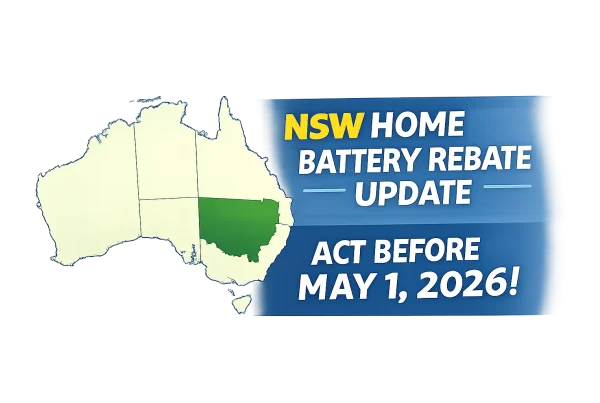
The NSW Government has replaced its stand‑alone battery rebate with an expanded incentive for households and small businesses that connect their battery to an approved VPP. From 1 July 2025, the scheme provides up to $1 500 per battery (varying with capacity)【584768056141721†L1044-L1051】. This incentive stacks with the federal discount, effectively doubling the current benefit【584768056141721†L1049-L1052】.
VPP participation means you agree to let your battery discharge some stored energy back to the grid during high‑demand events. In return, you receive the upfront incentive and ongoing payments for energy dispatched during events. We’ll explore the economics below.
3. Local Council & Additional Schemes
Hunter region councils occasionally offer micro‑grants or low‑interest loans for solar and battery systems【451474243509284†L107-L122】. These change regularly; ask your installer to check Maitland, Port Stephens or Lake Macquarie programs when you obtain quotes. For some customers, interest‑free loans may also be available through state schemes – making it easier to fund the net cost after rebates【451474243509284†L154-L161】.
How Virtual Power Plants Work
A virtual power plant aggregates the stored energy of many individual batteries and orchestrates their discharge to support the grid. Think of it as a neighbourhood of batteries acting together like a mini power station. During hot summer evenings when demand peaks and wholesale prices spike, the VPP operator can discharge energy from participating batteries to stabilise supply.
Benefits for homeowners
- Upfront payment: The NSW VPP incentive pays up to $1 500 for connecting your battery【584768056141721†L1044-L1051】.
- Ongoing earnings: Depending on the VPP program, you earn a credit each time your battery exports energy during a peak event. The Tesla Energy Plan historically pays 45–55 ¢/kWh for energy discharged【855444256254451†L120-L127】, while community VPPs via SolarHub or Amber have netted participants around $400 per year on a 10 kWh battery【855444256254451†L120-L128】. Actual returns depend on event frequency and battery size.
- Grid stability: By participating in a VPP, you help reduce demand on the grid and avoid price spikes. The NSW Government notes that VPPs make the state’s energy supply more stable and less prone to outages【584768056141721†L1066-L1069】, which in turn puts downward pressure on electricity prices【584768056141721†L1066-L1069】.
What’s required
- Compatible hardware and software: Your battery and inverter must support remote dispatch and communications with the VPP operator. Most modern systems (Tesla Powerwall 2/3, Pylontech Force 3Hx with GoodWe or Sungrow hybrid inverters, Sigenergy SigenStor) are VPP‑ready.
- Internet connection: Reliable internet is essential for the operator to monitor and control your system during events.
- Participation agreement: You sign a contract outlining event frequency, minimum state‑of‑charge requirements, compensation rates and opt‑out provisions.
Example pay‑back with VPP
Consider a 10 kWh battery costing $10 600 before rebates. After the 30 % federal discount (~$3 180) and a $1 200 NSW VPP incentive, the out‑of‑pocket cost is about $6 220. If you earn $400 per year from VPP events and save $1 400 per year in self‑consumption and avoided peak charges, your pay‑back drops to 3.3 years. Larger batteries benefit even more because the incentive scales with capacity and the VPP earnings increase.
Navigating the Rebate Application Process
The good news: You don’t apply for the federal discount or NSW VPP incentive yourself. Accredited installers and retailers handle the paperwork, but understanding the steps helps you choose the right provider.
Step 1: Confirm eligibility
- Check equipment: Ensure your chosen battery is on the Clean Energy Council’s approved list and is eligible under the federal program. Your installer should verify this.
- Accredited installer: Only Solar Accreditation Australia accredited electricians can claim STCs and the battery discount【451474243509284†L79-L83】. Ask for their accreditation number.
- Existing vs new solar: If you’re adding a battery to an existing PV system, make sure your current inverter is compatible or plan for a hybrid inverter upgrade. Retrofitting may not attract STCs, but the battery rebate still applies.
Step 2: Get a quote
Contact multiple local installers. The quote should show:
- Battery cost, including brand, capacity, warranty and installation.
- Federal discount (around 30 %, already deducted).
- NSW VPP incentive amount based on battery size.
- Net cost after incentives.
- Expected annual savings and VPP earnings (ask for a pay‑back estimate).
Step 3: Sign the contract and consent to VPP
Your installer will lodge the battery application through the Small‑scale Renewable Energy Scheme and the NSW VPP program. Review the VPP participation terms carefully. You may need to commit to a minimum number of events per year. Many programs allow you to opt out with notice but may require you to repay part of the incentive if you leave early.
Step 4: Installation and connection
Installation typically takes one day. Your installer will submit an Electrical Work Request and provide a compliance certificate under AS/NZS 5139. The VPP operator will commission your battery remotely and test communications. After a successful event or two, you’ll start seeing credits on your energy bill or from the VPP operator.
Step 5: Monitor and optimise
Use the battery app or portal to monitor state of charge, earnings and event history. Adjust your usage patterns (e.g. run dishwashers or EV chargers during the day) to maximise self‑consumption and leave capacity for VPP events. Most programs maintain a minimum state of charge for backup, so you don’t have to worry about losing power during a blackout.
Additional Solar and Battery Schemes in NSW
Beyond the main rebate stack and VPP incentive, there are other support mechanisms that can lower your costs or improve pay‑back:
- Interest‑free loans: Certain state programs offer loans for solar and batteries, repaid over 3–5 years. Repayments can be covered by bill savings【451474243509284†L154-L161】.
- Apartment & multi‑unit grants: NSW offers grants covering up to 50 % of a shared solar system cost for strata schemes【199746176293233†L97-L103】. This doesn’t apply to batteries directly but can free up cash to add storage.
- Local council rebates: Some councils run micro‑grants or rate rebates for rooftop solar and batteries【451474243509284†L107-L122】. Check your local council’s sustainability programs.
- Peak Demand Reduction Scheme: The NSW Government is exploring additional incentives for demand‑shifting technologies【584768056141721†L1088-L1090】. Battery storage and VPP participation are likely to feature prominently in future programs.
Frequently Asked Questions
Do I need a new inverter to access the rebates?
Not necessarily. AC‑coupled batteries like Tesla Powerwall can connect to most existing inverters. However, if your inverter is old, incompatible or nearing end‑of‑life, a hybrid inverter upgrade might be recommended. Upgrading can improve efficiency and enable DC‑coupled batteries like Pylontech or Sigenergy.
Will joining a VPP affect my battery warranty?
Most manufacturers allow VPP participation under warranty, but read the fine print. Warranties specify a maximum throughput (kWh) or number of cycles. VPP dispatch events count toward these limits, so ensure the program’s projected cycles fit within the warranty period. Your installer can estimate annual throughput.
How often will my battery discharge in a VPP?
It varies by program. Some VPPs dispatch only during extreme price spikes or grid emergencies, resulting in just a few events per month. Others operate daily to arbitrage price differences. The NSW incentive doesn’t limit how often your battery can be used, but the contract with the VPP operator does.
What happens if I move house?
If you sell your home or move, the VPP contract typically transfers to the new owner. You may need to repay part of the incentive if the contract ends early. Discuss this with your installer and real estate agent.
Can I combine the battery rebate with solar panel rebates?
Yes. You can claim the federal battery discount and NSW VPP incentive on top of STCs for your solar array. Some councils may limit you to one rebate at a time; check local rules.
Conclusion: Seize the 2025 Opportunity
The combination of federal and state incentives means solar batteries Newcastle have shifted from “nice to have” to financially compelling. With a 30 % upfront discount, an extra $1 500 for VPP participation and potential annual earnings of $400 or more, batteries now deliver pay‑backs under five years for typical households. Better yet, by joining a VPP you play a role in stabilising the grid and lowering energy prices for everyone【584768056141721†L1061-L1069】.
If you’re ready to tap into the 2025 rebate stack, request a quote or book a free battery consultation with Newy Solar Co. Our team handles all paperwork, ensures your system is VPP‑ready and designs a solution tailored to your home. Don’t miss out – demand is surging and programs are subject to change.
References
- NSW Climate and Energy Action. NSW & Commonwealth double incentives for batteries – outlines the Cheaper Home Batteries Program’s 30 % discount and the NSW VPP incentive up to $1 500【584768056141721†L1033-L1051】.【584768056141721†L1044-L1051】.
- NSW Climate and Energy Action. NSW & Commonwealth double incentives for batteries – gives example calculations showing that an 11.5 kWh battery could receive nearly $5 000 in support and a 27 kWh battery could receive a $10 000 discount plus $1 500 VPP payment【584768056141721†L1054-L1059】.
- NSW Climate and Energy Action. NSW & Commonwealth double incentives for batteries – notes that virtual power plants reduce demand on the grid, making electricity supply more stable and helping prevent price spikes【584768056141721†L1061-L1069】.
- Energy.gov.au. Cheaper Home Batteries Program – confirms that from 1 July 2025 the government funds around a 30 % discount on eligible small‑scale battery systems【63602032455628†L89-L104】.
- Energy.gov.au. Government rebates and loans for solar – explains that STC eligibility requires installation by Solar Accreditation Australia accredited installers and CEC‑approved equipment【451474243509284†L79-L83】 and that the battery discount is delivered through the SRES【451474243509284†L96-L103】.